
Comrat: Civil Society Discusses Electoral Integrity and Democratic Resilience
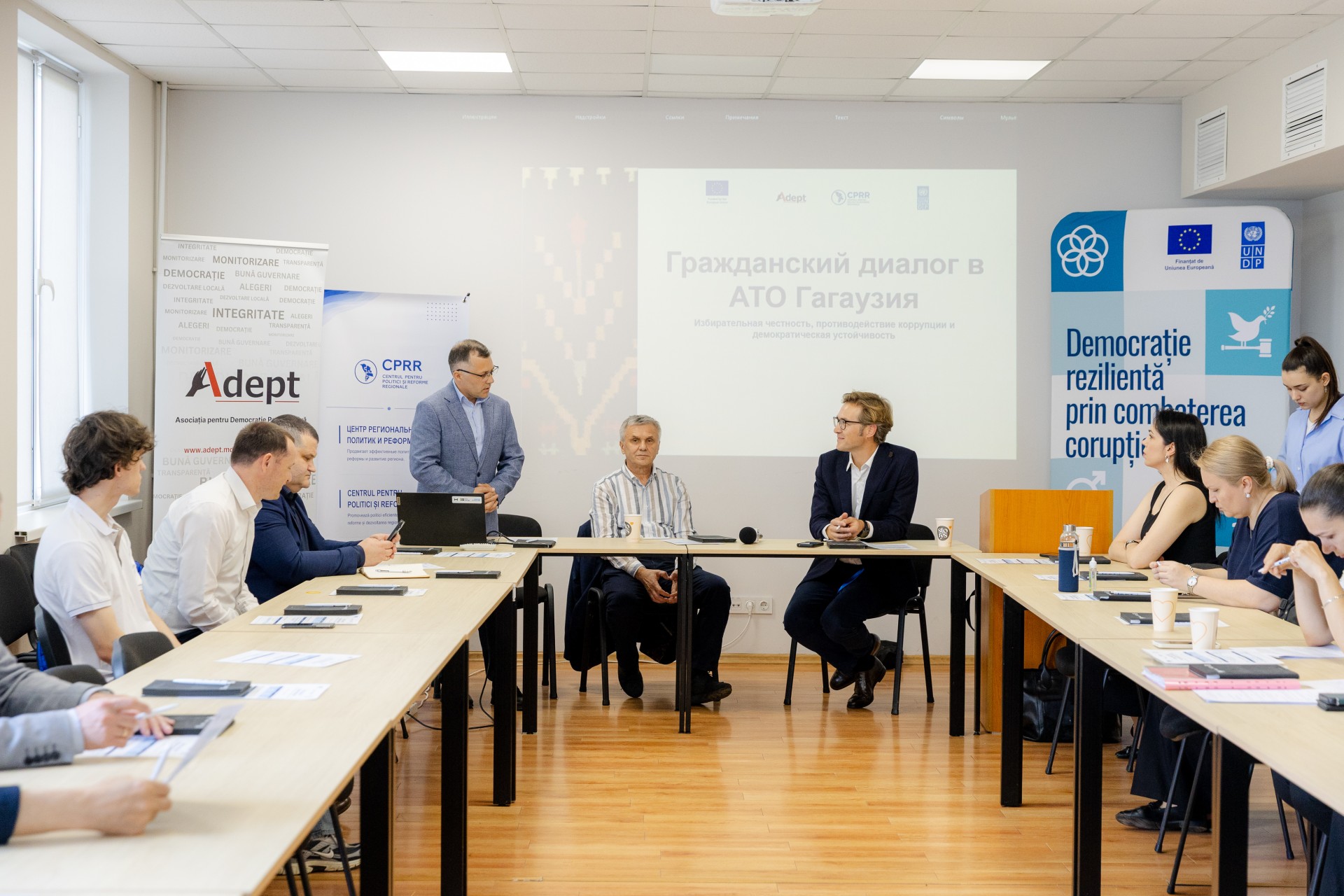
Electoral integrity, corruption prevention, disinformation, civic participation and strengthening public trust in institutions were the main topics discussed at the event “Civic Dialogue in the Gagauzia Region: Electoral Integrity, Anti-Corruption and Democratic Resilience”, organised in Comrat by the Association for Participatory Democracy ADEPT and the Centre for Regional Policies and Reforms in Comrat.
The event opened with an analysis presented by Igor Boțan, Executive Director of ADEPT, on the institutional crisis surrounding the elections for the People’s Assembly of Gagauzia. He outlined the context that led to the current deadlock, including divergences between the central authorities and the autonomy, legal disputes over electoral bodies, the suspension of certain administrative acts, and the need for a functional mechanism of cooperation between the central authorities and the autonomous region. According to the expert, the situation goes beyond the technical dimension of organising elections and raises important questions about the functioning of the rule of law, the application of the legal framework and the ability of institutions to identify solutions through dialogue and cooperation.
The role of local civil society was another important topic of discussion. Igor Guseinov, Director of the Centre for Regional Policies and Reforms in Comrat, underlined that civil society can contribute to identifying problems, formulating solutions and facilitating dialogue between citizens and authorities. In this regard, local organisations, community leaders, academia, the media and active citizens can play an important role in strengthening public participation and increasing trust in democratic processes. Participants also noted the need to strengthen the capacities of civil society at regional and local levels.
Particular attention was paid to the research, information and communication activities carried out by the Pro-EUROPA Association in Comrat, the Legal Clinic in Comrat and the “Vreau să cred” Association in Ceadîr-Lunga. These activities focused on women over the age of 55, a group that is active in electoral processes but exposed to a number of vulnerabilities. The research presented showed that women in this category vote, follow public life and want to better understand electoral processes. At the same time, they face economic hardship, social isolation, stereotypes, a lack of clear information and exposure to manipulation. Activities carried out in Copceac and Taraclia confirmed the importance of direct, simple communication adapted to the language spoken in the community. Information materials were developed and distributed in Romanian, Gagauz, Bulgarian and Russian to facilitate access to accurate and accessible electoral information.
Cybersecurity expert Dinu Țurcanu spoke about the risks in the online space, drawing attention to the evolving forms of digital manipulation, including coordinated networks, fake accounts, AI-generated content, pages impersonating institutions or credible media sources, and artificially amplified messages. His recommendation focused on applying the “zero trust” principle: online information, especially images, videos, polls and alarmist messages, should be verified through independent sources before being shared. In an electoral context, verifying information becomes a form of civic responsibility.
The event was organised by the Association for Participatory Democracy ADEPT and the Centre for Regional Policies and Reforms in Comrat, with the support of the “Resilient Democracy through Anti-Corruption” project (REDACT), implemented by UNDP Moldova and funded by the European Union. The opinions expressed during the event belong to the authors and participants and do not necessarily reflect the position of the European Union or UNDP Moldova.