
Police, prosecutors and journalists join efforts to strengthen press safety in the Republic of Moldova
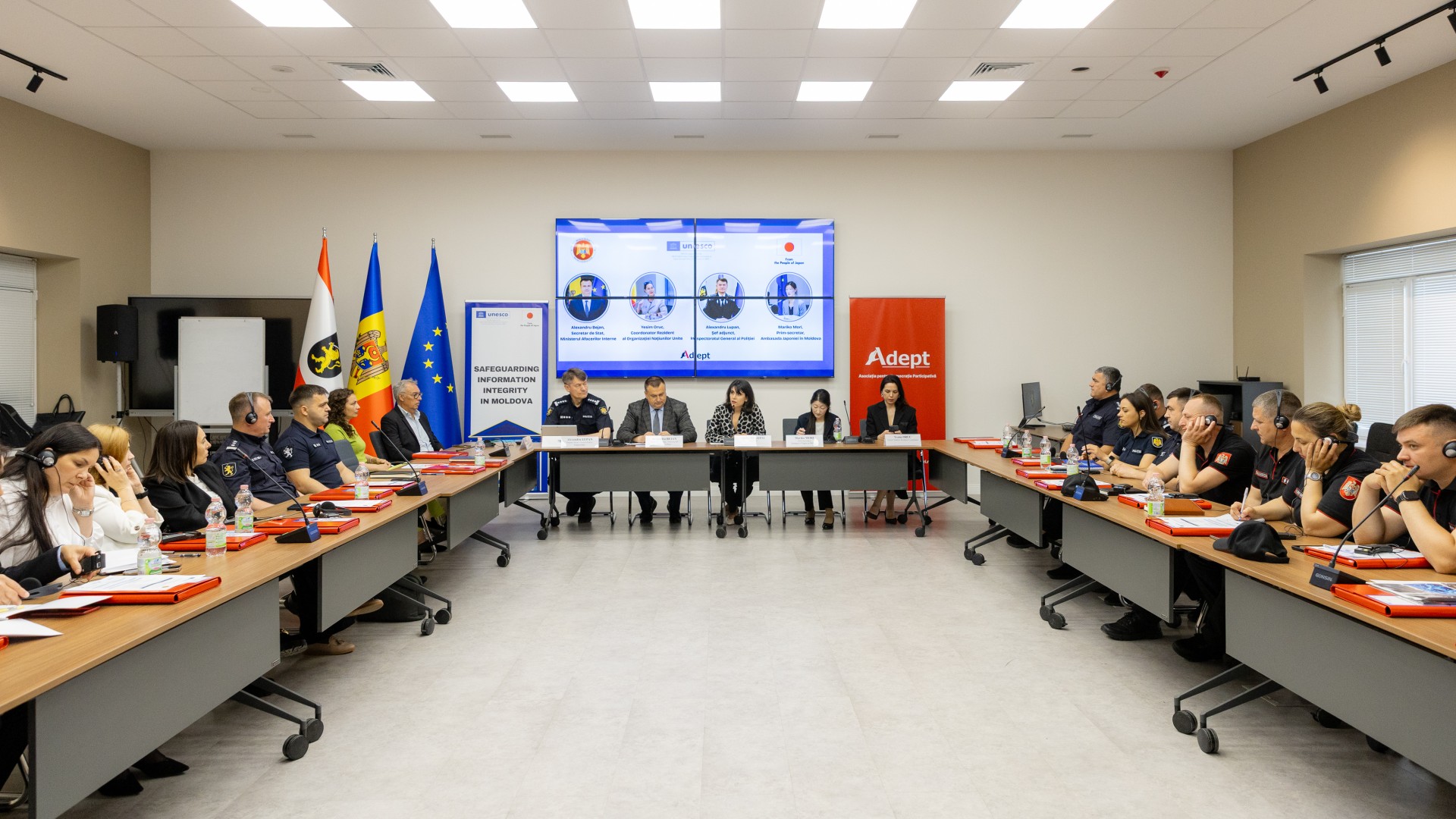
Representatives of law enforcement agencies, the Prosecutor’s Office and the media took part in an intensive training programme on freedom of expression and the safety of journalists, held in Chișinău from 26 to 29 May 2026.
The event brought together police officers, carabinieri, prosecutors, investigation officers and journalists in a practical format designed to strengthen trust, professional communication and operational cooperation between state institutions and media representatives. Over the four days, participants examined international standards on freedom of expression, the safety of journalists and access to information, discussed challenges specific to the Republic of Moldova, and worked on practical response tools for addressing attacks against journalists.
The programme contributes to the implementation of the Interministerial Action Plan on the Safety of Journalists, which provides a national framework for strengthening cooperation among relevant public institutions, media organizations and civil society. In this context, the training supports the translation of institutional commitments into practical skills, applicable procedures and coordination mechanisms for preventing, documenting and investigating incidents targeting media representatives, including online and in the context of protests.
The activity is part of broader efforts to strengthen information integrity and protect freedom of expression in the Republic of Moldova, in a context marked by pressures on the information space, online harassment, risks during public demonstrations, and the need for a clearer and more coherent institutional response to threats against media workers.
“Journalists’ safety is an essential condition for freedom of expression, public access to information of public interest, and the democratic functioning of society. Through this training, UNESCO supports national institutions in translating international standards into concrete practices applicable in the day-to-day work of police officers, prosecutors and other actors responsible for protecting fundamental rights,” said Mehdi Benchelah, UNESCO representative.
The training agenda included sessions dedicated to the international and national legal framework, the role of law enforcement institutions in protecting freedom of expression, the professional relationship between police and the media, communication in high-pressure situations, and the investigation of attacks against journalists, including those committed online. The practical component of the programme included simulated press conferences, scenarios on journalists’ access to incident sites, an exercise on managing a protest situation, and case studies on online attacks against media representatives. These activities aimed to develop concrete skills for interaction between law enforcement institutions and the press in real-life situations.
“The Interministerial Action Plan on the Safety of Journalists creates the necessary framework for clearer and more effective cooperation between state institutions, the press and civil society. However, the value of such a document depends on how it is applied in practice. This training contributes precisely to that objective: transforming commitments into procedures, skills and functional mechanisms for the protection of journalists,” said Alexandru Bejan, State Secretary at the Ministry of Internal Affairs.
The training provided a platform for direct dialogue between police officers and journalists, two professional groups that frequently interact in situations of public interest, including protests, security-related events, investigations and crises. Discussions highlighted that many tensions between authorities and the press can be prevented through clear procedures, timely communication, mutual respect and a better understanding of institutional mandates.
“The Police have the responsibility to protect public order and personal safety, while also ensuring respect for fundamental rights. A professional relationship with the press is essential for public trust. Through this training, we aim to strengthen police officers’ capacity to interact appropriately with journalists, prevent risks and respond effectively when media representatives are intimidated, threatened or attacked,” said Alexandru Lupan, Deputy Head of the General Police Inspectorate.
On the fourth day, participants from the Police, the Carabinieri and the Prosecutor’s Office discussed the key elements of a future guide/instructions for investigating attacks against journalists. This exercise represents a direct contribution to the implementation of the Interministerial Action Plan by clarifying procedures for receiving and registering complaints, investigating physical and online attacks, ensuring interinstitutional cooperation in complex cases, and communicating with victims and the public throughout investigations.
This component is directly linked to the objectives of the project implemented by ADEPT in partnership with UNESCO, which supports the strengthening of institutional capacities in Moldova and the development of recommendations and tools designed to contribute to a safer environment for the press and more effective cooperation between authorities, the media and civil society.
“For ADEPT, this programme is important because it connects freedom of expression with institutional responsibility and democratic resilience. The safety of journalists is a condition for citizens’ access to verified information, for institutions to be held accountable, and for public debate to remain open. Our role is to contribute to a professional, well-structured and solution-oriented dialogue among institutions, the press and civil society,” said Polina Panainte, Deputy Director of the Association for Participatory Democracy ADEPT.
Through this training, the Republic of Moldova takes a concrete step towards strengthening institutional mechanisms for the protection of journalists and bringing national practices closer to international standards on freedom of expression and press safety.
The event is implemented under the UNESCO Multi-Donor Programme on Freedom of Expression and Safety of Journalists, in partnership with the Ministry of Internal Affairs of the Republic of Moldova, the General Police Inspectorate and the Association for Participatory Democracy ADEPT, with the financial support of the Government of Japan.